






A little research. A more confident next move. Meet our methodology ↗
FXBench
FXBench

Best Floating-Spread CFD Brokers for 2026

Time to read: 9 minutes

Posted: 15 Sep 2026
best floating spread forex brokers
Table of Contents

Six brokers were compared for floating-spread trading based on pricing, commissions, platforms, account requirements, and regulatory structure.

Pepperstone ranks best overall for its balance of competitive Raw pricing, platform choice, and accessibility. Axi stands out for low commission-based costs, while IC Markets is particularly suited to scalping and automated trading.

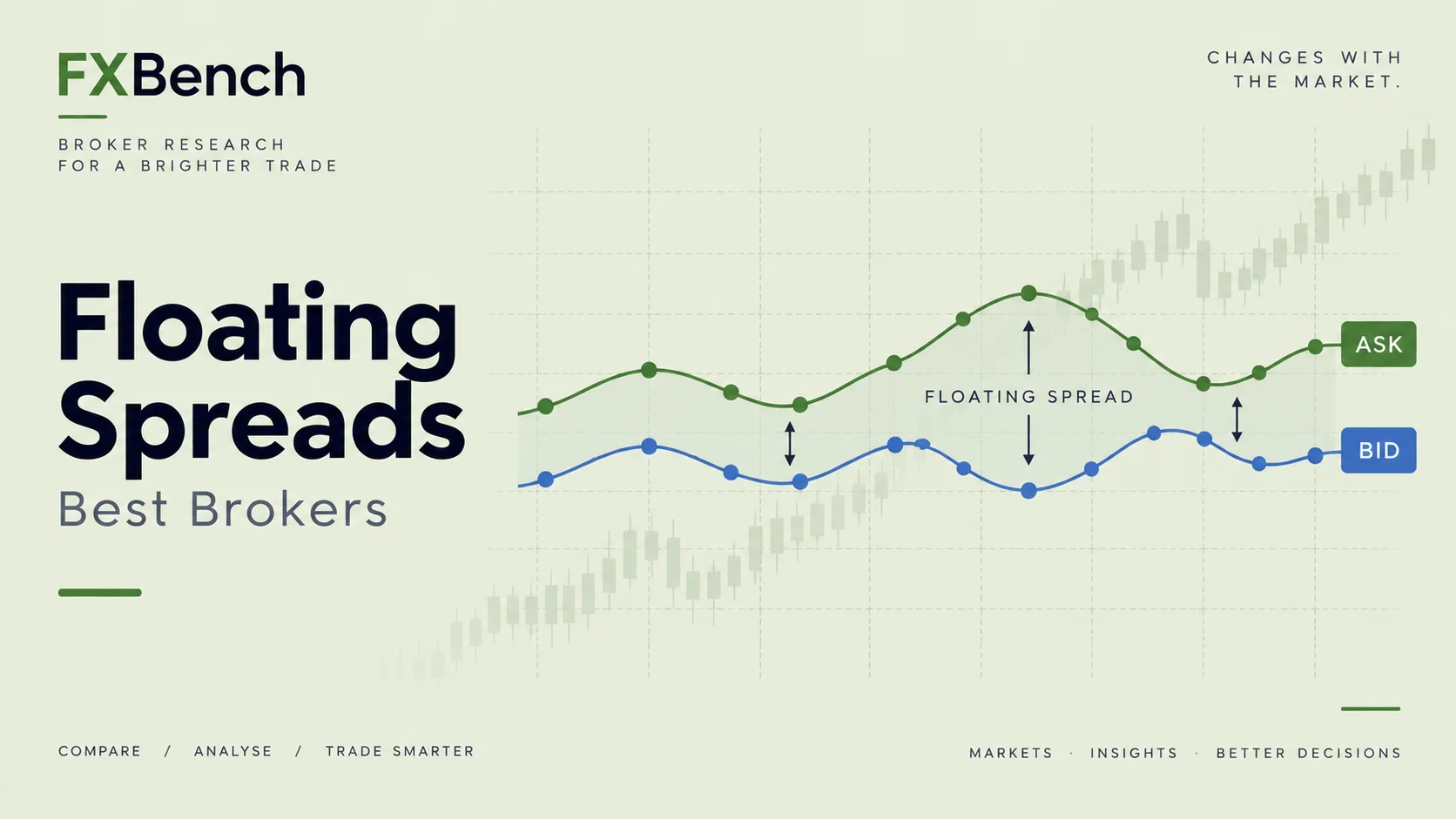
Floating spreads change with liquidity and volatility, so minimum spreads alone do not show what a trader is likely to pay.

Best Floating-Spread CFD Brokers Compared

Broker Best For EUR/USD Spread Commission Min. Deposit Platforms
Pepperstone Best Overall 0.1 pips avg., Razor $7 RT on MT4/5 $10 MT4, MT5, cTrader, TradingView, Pepperstone
Axi Lowest All-In Cost 0.0 pips avg., Pro $4.50 RT $100 recommended MT4, MT5, WebTrader, Axi
IC Markets Scalping & Automation 0.1 pips avg., Raw $7 RT on MT4/5 $200 MT4, MT5, cTrader, TradingView, WebTrader
FP Markets Multi-Asset Raw Trading 0.1 pips avg., Raw $6 RT in USD $100 MT4, MT5, cTrader, TradingView
Vantage Copy Trading About 0.06 pips, Raw ECN $6 RT $50 MT4, MT5, TradingView, Vantage Web, Vantage App
FXGlory Fixed and floating spreads option 0.1 pips avg., ECN $0 on most accounts; ECN varies $1 MT4, MT5, WebTrader, GloryTrader

Our Top Floating-Spread CFD Brokers

1. Pepperstone: Best Floating-Spread CFD Broker Overall

Pepperstone takes the top position because it combines transparent Raw pricing with one of the widest platform selections in the group. Its Razor structure suits active traders, while Standard pricing gives less frequent traders a simpler spread-only alternative.

The main drawback is commission: MetaTrader Razor pricing costs more per round turn than Axi, FP Markets, and Vantage. Even so, the broader trading setup makes Pepperstone the strongest all-around choice rather than the cheapest specialist option.

Key Facts

Feature Details
Best For Overall floating-spread trading
Typical EUR/USD Spread 0.1 pips average on Razor
Commission $7 round turn on USD MT4/MT5 Razor; cTrader pricing differs
Minimum Deposit $10
Platforms MT4, MT5, cTrader, TradingView, Pepperstone platform
Account Types Standard, Razor; additional structures vary by jurisdiction
Maximum Leverage Up to 1:1000 for eligible professional/international clients
Regulator / Entity Multi-entity group including FCA, ASIC, CySEC, DFSA, BaFin, CMA and SCB-regulated operations

Strengths

  • Supports MT4, MT5, cTrader, TradingView, and a proprietary platform.
  • Low entry requirement for a broker offering Raw pricing.
  • Standard and Razor accounts cover different trading frequencies.

Limitations

  • MetaTrader Razor commission is higher than several competitors.
  • Leverage and investor protection depend on the regulatory entity.

Best For

Pepperstone best suits traders who want competitive variable pricing without being tied to one platform or one account model.

2. Axi: Best for Lowest All-In Cost

Axi ranks second because its Pro account produces the lowest straightforward EUR/USD transaction cost in this comparison. Its pricing is particularly attractive to traders whose strategy depends more on low per-trade costs than platform variety.

The main compromise is a more MetaTrader-centered setup. Traders seeking native cTrader or TradingView execution have broader options elsewhere.

Key Facts

Feature Details
Best For Low Raw-account commission
Typical EUR/USD Spread 0.0 pips average on Pro
Commission $4.50 round turn on Pro
Minimum Deposit $100 recommended
Platforms MT4, MT5, WebTrader, Axi Trading Platform
Account Types Standard, Pro, Elite, Swap-Free; availability varies
Maximum Leverage Up to 1:1000 on eligible international accounts
Regulator / Entity Group entities include businesses regulated by the FCA and ASIC; international conditions depend on the account entity

Strengths

  • Lowest Raw-style commission in this comparison.
  • Well suited to scalping, Expert Advisors, and VPS-based trading.
  • Standard pricing is available for traders who do not want to pay a separate commission.

Limitations

  • Narrower platform range than Pepperstone or IC Markets.
  • Trading conditions vary between international and locally regulated entities.

Best For

Axi fits cost-sensitive forex traders who primarily use MetaTrader and prioritize lower commission over a larger platform ecosystem.

3. IC Markets: Best for Scalping and Automated Trading

IC Markets is the strongest specialist option for traders who scalp, use Expert Advisors, or run systematic strategies. Its Raw structure is closely integrated with MetaTrader and cTrader rather than being a secondary account offering.

The higher minimum deposit and standard Raw commission keep it behind Pepperstone and Axi overall, but its execution-focused environment remains a better fit for frequent automated trading.

Key Facts

Feature Details
Best For Scalping and automated strategies
Typical EUR/USD Spread About 0.1 pips on Raw pricing
Commission About $7 round turn on USD MetaTrader Raw pricing
Minimum Deposit $200
Platforms MT4, MT5, cTrader, TradingView, WebTrader
Account Types Standard and Raw structures, including platform-specific Raw accounts
Maximum Leverage Up to 1:1000 under eligible IC Markets Global conditions
Regulator / Entity Raw Trading Ltd, FSA Seychelles license SD018 for IC Markets Global; other group entities vary by jurisdiction

Strengths

  • Strong MetaTrader and cTrader support for automated systems.
  • Scalping is permitted.
  • Raw pricing is central to its account structure.
  • TradingView and VPS support broaden strategy options.

Limitations

  • $200 minimum deposit is one of the highest in the group.
  • Its standard Raw commission is not the lowest.

Best For

IC Markets is most suitable for scalpers and algorithmic traders who value execution tools and platform infrastructure over a lower account-entry threshold.

4. FP Markets: Best for Multi-Asset Raw Trading

FP Markets combines competitive Raw pricing with broader CFD coverage. Its account structure is straightforward, and the $6 round-turn commission places it below Pepperstone and IC Markets on commission cost.

Its main appeal is versatility: traders get access to MT4, MT5, cTrader, and TradingView while also having a wider range of non-forex CFDs available from the same broker.

Key Facts

Feature Details
Best For Raw forex pricing with broad CFD access
Typical EUR/USD Spread 0.1 pips average on Raw
Commission $6 round turn in USD
Minimum Deposit $100
Platforms MT4, MT5, cTrader, TradingView
Account Types Standard and Raw
Maximum Leverage Up to 1:500, entity and instrument dependent
Regulator / Entity Group entities regulated by ASIC, CySEC, FSCA, FSA Seychelles, and CMA Kenya

Strengths

  • Competitive commission structure.
  • Broad platform coverage.
  • Large CFD range beyond currency pairs.

Limitations

  • $100 entry requirement is above Pepperstone and Vantage.
  • Conditions differ across regulatory entities.

Best For

FP Markets suits traders who want Raw forex pricing while also trading indices, commodities, shares, crypto, or ETF CFDs.

5. Vantage: Best for Copy Trading

Vantage combines Raw ECN pricing with one of the stronger copy-trading setups in the group. Its platform range works well for traders who alternate between independent trading and following other strategies.

Its pricing is competitive, but Vantage stands out more for how its mobile, web, MetaTrader, TradingView, and copy-trading tools fit together than for one individual cost metric.

Key Facts

Feature Details
Best For Copy trading with Raw pricing
Typical EUR/USD Spread 0.06 pips average on Raw ECN
Commission $6 round turn
Minimum Deposit $50 recommended for Raw ECN
Platforms MT4, MT5, TradingView, Vantage Web, Vantage App
Account Types Standard STP, Raw ECN and other entity-specific accounts
Maximum Leverage Varies by entity, account classification, and jurisdiction
Regulator / Entity International and regional operations include entities regulated by the VFSC, ASIC, and FSCA

Strengths

  • Competitive Raw ECN commission.
  • Integrated copy-trading ecosystem.
  • Strong mobile, web, MetaTrader, and TradingView coverage.

Limitations

  • Entity structure makes trading conditions less uniform across clients.
  • Leverage and protection levels depend heavily on jurisdiction.

Best For

Vantage is best suited to traders who want Raw pricing alongside copy trading and flexible mobile execution.

6. FXGlory: Best for High-Leverage Floating-Spread Trading

FXGlory offers both fixed and floating spreads, giving traders more pricing flexibility than its earlier fixed-spread-focused structure. Its newer account lineup includes lower-spread options alongside commission-free accounts, while leverage reaches 1:3000 for eligible balances.

Key Facts

Feature Details
Best For High-leverage fixed and floating-spread trading
Typical EUR/USD Spread 0.1 pips average; account-specific pricing varies
Commission Commission-free accounts available; ECN commission varies by asset
Minimum Deposit $1 on Standard/Classic; $3,500 on ECN
Platforms MT4, MT5, WebTrader, GloryTrader
Account Types Standard, Premium, VIP, Classic, Pro, ECN
Maximum Leverage Up to 1:3000 on eligible accounts
Regulator / Entity FXGlory Ltd, regulated by IFSA

Strengths

  • Both fixed and floating spread options are available.
  • Commission-free pricing is available.
  • MT4 and MT5 support automated and manual trading.

Limitations

  • The ECN structure has a substantially higher deposit requirement.

Best For

FXGlory is best suited to experienced traders who prioritize high leverage, floating-spread access, flexible account options, and a low starting deposit. Traders who place greater weight on regulatory coverage may prefer one of the other brokers in the comparison.

Standard vs Raw Floating-Spread Accounts

Standard Floating-Spread Accounts

Standard accounts usually build the broker's markup into the spread instead of charging a separate forex commission. They suit occasional traders who prefer simpler cost tracking over the narrowest possible quoted spread.

Raw Floating-Spread Accounts

Raw accounts use tighter underlying pricing and charge commission separately. They are generally more relevant to scalpers, algorithmic traders, and high-volume users, where small differences in transaction cost accumulate quickly.

How Floating Spreads Can Change

Floating spreads respond to market conditions. They often widen around major economic releases, unexpected volatility, session transitions, rollover, and periods of weak liquidity.

Broker selection should therefore reflect when a strategy trades. A system operating during the London and New York session overlap faces different spread conditions from one entering around news releases or thin overnight markets.

Floating Spread vs Total Trading Cost

The lowest quoted spread does not automatically produce the lowest trading cost. Commission, average spread, financing, execution, slippage, and account requirements all matter.

For example, a 0.1-pip EUR/USD spread is about $1 on one standard lot. Adding a $7 round-turn commission raises the estimated transaction cost to $8 before slippage or overnight charges. A 0.0-pip average with a $4.50 commission costs about $4.50 under the same assumptions.

How to Choose a Floating-Spread CFD Broker

Use Typical Spreads, Not Only Minimums

Minimum spreads show the best available pricing. Average or typical figures give a more useful picture of normal trading costs.

Add the Commission

Include both sides of the commission before comparing Raw accounts. A 0.0-pip minimum does not mean free execution.

Compare the Right Account Type

Compare Raw with Raw and Standard with Standard to avoid mixing different pricing models.

Check the CFDs You Trade Most

EUR/USD is a useful benchmark, but gold, indices, crypto, shares, and exotic currencies often have very different cost structures.

Consider Spread Behavior During Volatile Markets

Short-term strategies should pay particular attention to pricing during news releases, rollover, and other periods when spreads tend to expand.

Match the Platform to Your Trading Style

MetaTrader suits Expert Advisor users, cTrader provides strong execution and depth-of-market tools, and TradingView is useful for chart-centered workflows.

Best Floating-Spread CFD Broker by Priority

Priority Best Broker Why
Best Overall Pepperstone Best balance of pricing, platforms, and regulatory coverage
Lowest All-In Cost Axi Lowest estimated cost among comparable Raw-style accounts
Best Raw Account IC Markets Strong setup for scalping and automated execution
Best Commission-Free Account FXGlory Commission-free pricing is available on selected accounts
Best for Scalping IC Markets Raw pricing with execution tools for frequent trading
Best Platforms Pepperstone Broadest combination of major third-party and proprietary platforms

Final Verdict

Best Overall: Pepperstone. The strongest choice for traders who want competitive floating spreads, broad platform access, and flexible account structures.

Best Raw Pricing: Axi. The better fit for traders focused primarily on minimizing commission-based forex costs.

Best for Scalping and Automation: IC Markets. A more specialized choice for frequent and algorithmic trading.

How We Review CFD Brokers

Broker comparisons assess pricing, account structure, regulation, execution, platforms, funding requirements, and strategy suitability. See the full CFD Broker Review Methodology.

FAQ

What is a floating spread?

A floating spread is the difference between bid and ask prices that changes with liquidity and volatility.

Can a floating spread reach 0.0 pips?

Yes. Raw accounts sometimes reach 0.0 pips, but commission still applies, and zero pricing is not maintained continuously.

Why do floating spreads widen?

Spreads widen when liquidity falls or volatility increases, including during major news events, rollover, and thin trading periods.

Are floating spreads cheaper than fixed spreads?

They often become cheaper during liquid market conditions, while fixed spreads provide greater predictability. The better model depends on trading frequency and timing.

Are floating spreads better for scalping?

Raw floating spreads are often better suited to scalping because frequent traders benefit more from tighter bid-ask pricing, provided commission remains competitive.

What is the difference between Raw and Standard floating spreads?

Standard accounts usually include the broker's markup in the spread. Raw accounts offer tighter pricing and charge a separate commission.

Carrie Hobbs Author

Carrie Hobbs

Carrie Hobbs reviews forex brokers with a practical, detail-oriented approach. Her work helps both beginner and experienced traders evaluate platform features, pricing, regulatory standards, account options, and broker reliability before choosing a trading provider.

Leave Your Comment

Score

Other Articles